ICC Special Inspection
Ensuring Code Compliance Through Expert Inspection
 The International Code Council (ICC) was established in 1994 as a non-profit organization dedicated to developing a single set of comprehensive and coordinated construction codes aimed at protecting the health, safety, and welfare of the public at large by creating safe buildings and communities. ICC Special Inspection involves the inspection of select construction practices by certified ICC Special Inspectors to help ensure adherence to local, national, and/or international building codes and standards. ICC Special Inspectors are required to demonstrate the ability to apply technical specification and code compliance through the completion of the ICC examination and certification process. ICC certification examinations are maintained to the highest standards and include continuous review by committees of experienced professionals. Most building departments, state agencies, and third-party entities recognize ICC certification as the single most significant codes and standards credentials that building professionals can attain.
Our ICC Special Inspectors maintain current certifications in all of their respective inspection disciplines, and maintain the highest level of integrity, honesty, and fairness required by the ICC Code of Ethics (see below). Our ICC Special Inspectors are recognized by both local contractors and code enforcement officials as being consummate professionals and are setting the bar for ICC Special Inspection in Alaska.
ICC Code of Ethics
The protection of the health, safety and welfare of the public, by creating safe buildings and communities, is the solemn responsibility of the International Code Council (“ICC”) and all who participate in ICC activities.
Recognizing this, the ICC advocates commitment to a standard of professional behavior that exemplifies the highest ideals and principles of ethical conduct. The governing concepts embodied in this philosophy are characterized herein, for the benefit and guidance of those so engaged, and for the enlightenment of the public so served.
Each individual participating in an ICC activity shall:
- Support the mission of the ICC to provide the highest quality codes, standards, products and services for all concerned with the safety and performance of the built environment.
- At all times, act in an ethical manner, comply with the ethical rules and regulations related to his or her profession, and avoid conflicts of interest.
- Demonstrate integrity, honesty, and fairness while participating in ICC activities.
- For ICC certified individuals, maintain professional competence in all areas of employment responsibility and encourage the same for colleagues and associates.
- Act in accordance with the Bylaws and Policies of the International Code Council, including this Code of Ethics.
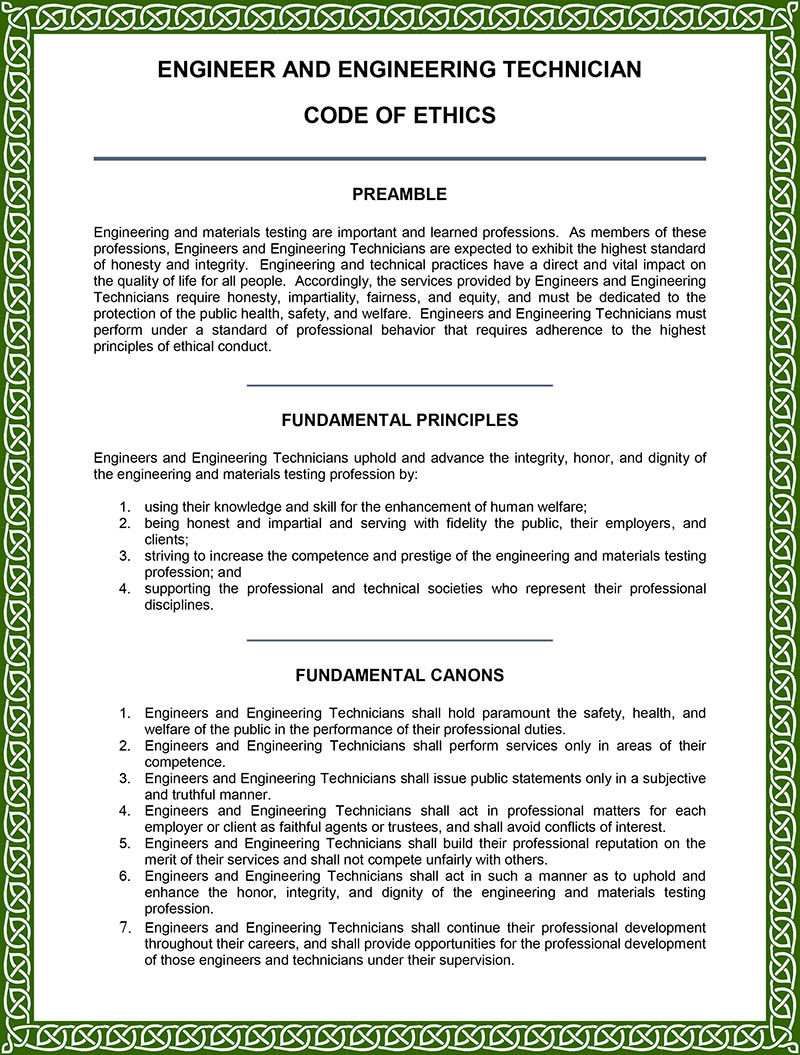
Code of Ethics
Engineers and Engineering Technicians shall continue their professional development throughout their careers, and shall provide opportunities for the professional development of those engineers and technicians under their supervision.
Preamble
Fundamentals & Principles
Engineers and Engineering Technicians uphold and advance the integrity, honor, and dignity of the engineering and materials testing profession by:
- using their knowledge and skill for the enhancement of human welfare;
- being honest and impartial and serving with fidelity the public, their employers, and clients;
- striving to increase the competence and prestige of the engineering and materials testing profession; and
- supporting the professional and technical societies who represent their professional disciplines.
Fundamentals Cannons
- Engineers and Engineering Technicians shall hold paramount the safety, health, and welfare of the public in the performance of their professional duties.
- Engineers and Engineering Technicians shall perform services only in areas of their competence.
- Engineers and Engineering Technicians shall issue public statements only in a subjective and truthful manner.
- Engineers and Engineering Technicians shall act in professional matters for each employer or client as faithful agents or trustees, and shall avoid conflicts of interest.
- Engineers and Engineering Technicians shall build their professional reputation on the merit of their services and shall not compete unfairly with others.
- Engineers and Engineering Technicians shall act in such a manner as to uphold and enhance the honor, integrity, and dignity of the engineering and materials testing profession.
ICC Special Inspection Services
At NGE-TFT, we provide a full range of specialized inspection services designed to ensure the quality and safety of your construction projects. Our expertise includes Concrete Placement, Rebar Inspection, Fire Proofing, High Strength Bolting, Drilled In Concrete Anchors (DICA), Masonry (CMU), Pre-Stressed Post-Tensioning Concrete, Welding Inspection, Structural Wood Framing, and Soils Inspections. With a focus on accuracy and compliance, we deliver thorough assessments across various construction elements to help ensure the long-term durability and integrity of your structures.
Concrete Placement
Concrete Rebar Inspection
Rebar inspections are performed by ICC Reinforced Concrete certified special inspectors. Rebar is a key element in a concrete structure. Our inspectors have the responsibility to review structural drawings and then verify that structural elements are built to the drawings as well as the governing code. Rebar size and grade along with how the rebar is placed are critical in the structural design of each element.
Drilled in Concrete Anchors DICA
Post installed concrete anchors require special inspection. Verification of required type of anchor is performed. This includes type, grade and length. There are several different types and methods that can be used and it is the responsibility of the inspector to ensure that only the specified type approved by the engineer of record is used. Hole depths and cleaning of hole is verified along with proper installation of the post installed anchor. Testing of anchors can be done with calibrated torque wrench or pull test can be performed.
Fire Proofing
Fire proofing is performed by certified ICC Fire Proofing special inspectors. Inspections include prep work on substrate surface conditions, proper temperatures for approved fire proofing material being used. Finished product visual inspection is conducted followed up by performing thickness testing, density testing and cohesion/adhesion testing.
High Strength Bolting Inspection
Our inspectors are certified ICC Structural Steel and Bolting Special Inspectors. Inspections are performed on all structural joints and bolted connections. Observations are done per AISC, American Institute of Steel Construction. Bolts are tested prior to installation using a Skidmore bolt testing apparatus. Reviewing mill certs and lot numbers on each batch of bolts is performed. Methods of installed bolt testing are: turn of the nut, twist off bolts, direct tension indicators, snug tight fit application. Observation of faying surfaces preparation is also part of bolting inspection.
Masonry Inspection CMU Concrete Masonry Unit
Our inspectors are certified ICC Structural Steel and Bolting Special Inspectors. Inspections are performed on all structural joints and bolted connections. Observations are done per AISC, American Institute of Steel Construction. Bolts are tested prior to installation using a Skidmore bolt testing apparatus. Reviewing mill certs and lot numbers on each batch of bolts is performed. Methods of installed bolt testing are: turn of the nut, twist off bolts, direct tension indicators, snug tight fit application. Observation of faying surfaces preparation is also part of bolting inspection.
Pre Stressed Post Tensioning Concrete
Pre-stressed and post tensioned inspections are done by certified ICC Pre-Stressed Concrete special inspectors. Inspections involve placement of rebar and tendons, layout of tendons, tendon drape, proper tendon head placement, tensioning of tendons and recording elongations. Monitoring concrete curing temperatures and strength is also performed.
Welding Inspection
Our welding inspectors are AWS certified welding inspectors. Welding inspections consist of 100% visual of all welds. 100% inspections are performed on all full penetration and partial penetration welds. 100% UT, ultrasonic testing, is performed on all full pen welds. If required, other procedures are performed such as magnetic particle testing and liquid penetrant testing. Review of welding certs and procedures are done prior to welding. Joint prep, preheat and interpass temperatures are monitored. Inspections are performed in fab shops and in the field. Inspections are performed per the latest welding codes.
Structural Wood Framing
Wood framing inspections start in the foundation walls/footings with seismic anchors embedded in the concrete. From there, sill plate bolting and hold downs are inspected. Following load paths, seismic straps are followed up to the roof diaphragms and drag struts. Shear wall nailing along with floor and roof nailing are also inspected.
Soils Inspection
Soils inspection is performed by certified ICC Soil Special Inspectors, Civil Engineers or Certified Professional Geologists. We perform bottom of hole inspection, excavation and material fill inspections.